
GPS tracking collars
Tracks every animal's location in real time. Reports to a server, not the elephant wearing it.
Fun fact Elephants are so smart they can remove the devices!
- Location data
- Animal warning
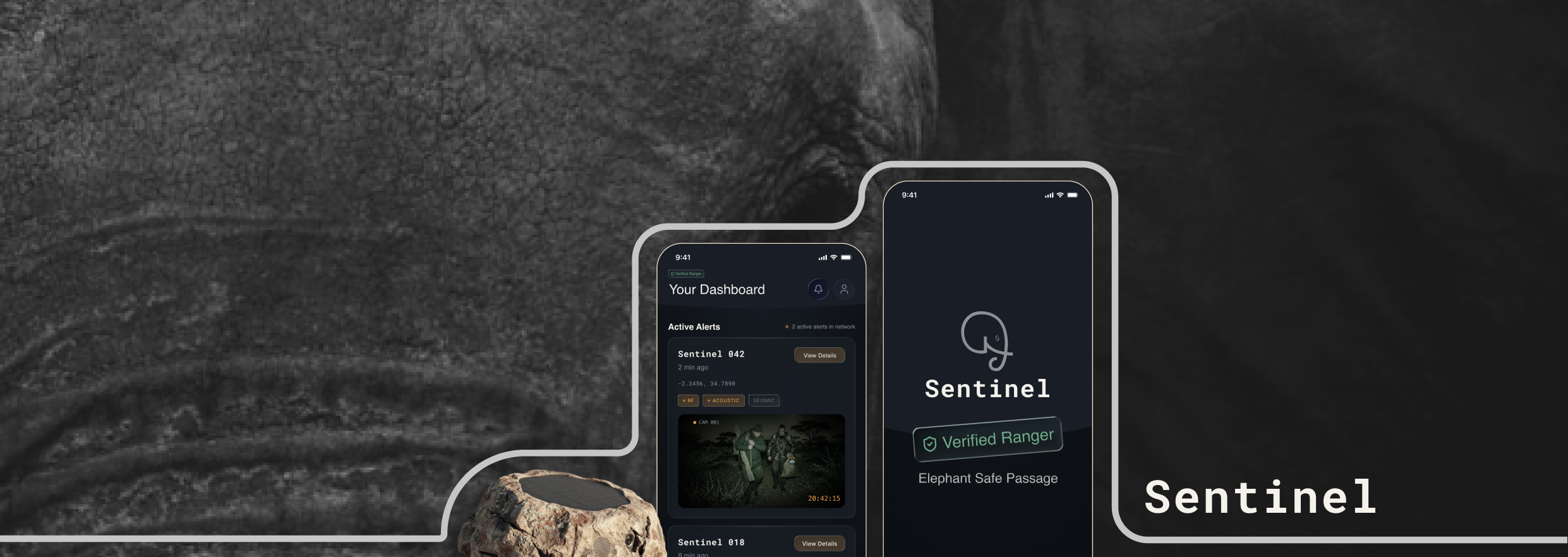
Case Study
THE PROBLEM
GPS collars on the elephants. Drones overhead. Rangers at a dashboard far away. The tech keeps getting better at watching. The elephants get nothing back. Subject of the data, never the audience.
Tracks every animal's location in real time. Reports to a server, not the elephant wearing it.
Fun fact Elephants are so smart they can remove the devices!
Photographs the herd from above. The view is for the pilots. The elephant on the ground learns nothing.
Plots threats on a screen kilometers away. By the time the alert lands, the ranger still has to drive out.
A herd grazes four hundred meters from a poaching crew. The dashboard knows. The ranger forty kilometers away knows. The elephant doesn't.
Protected land keeps thinning. Poaching targets matriarchs because they hold the herd's memory of safe routes and water. Kill one and that memory goes with her (Bradshaw, 2009).
THE QUESTION
How might a sensor network warn elephants directly, in a sensory channel they already use, with humans in a supporting role?
Three constraints fell out of this. Speak a language elephants already understood. Support the matriarch's leadership, not override it. Work across thousands of square kilometers with patchy infrastructure.
RESEARCH
How elephants already communicate
Elephants have one of the best-documented communication systems in the animal kingdom. An adult female knows the infrasonic calls of about 100 individuals across 14 family groups. Over 200 signals span visual, acoustic, tactile and chemical channels. They even read ground vibrations through their feet, called seismic listening (McComb et al., 2000; Poole & Granli, 2009).
They weren't waiting to be warned. They already had a system. The Sentinel could plug into it.

| Behavior | Observation | Context | Frequency |
|---|---|---|---|
| Trunk-to-Mouth | Trunk tip inserted into another’s mouth | Greeting or reassurance | Frequent during transit |
| Ear Flaring | Ears extended laterally, head elevated | Perceived threat | Increased near roads and fencing |
| Dust Bathing | Soil lifted and thrown over back repeatedly | Cooling and regulation | Often observed following disturbance |
| Seismic Listening | Standing still with weight shifted forward | Long-distance communication | Common at dawn and dusk |
Where elephants actually move
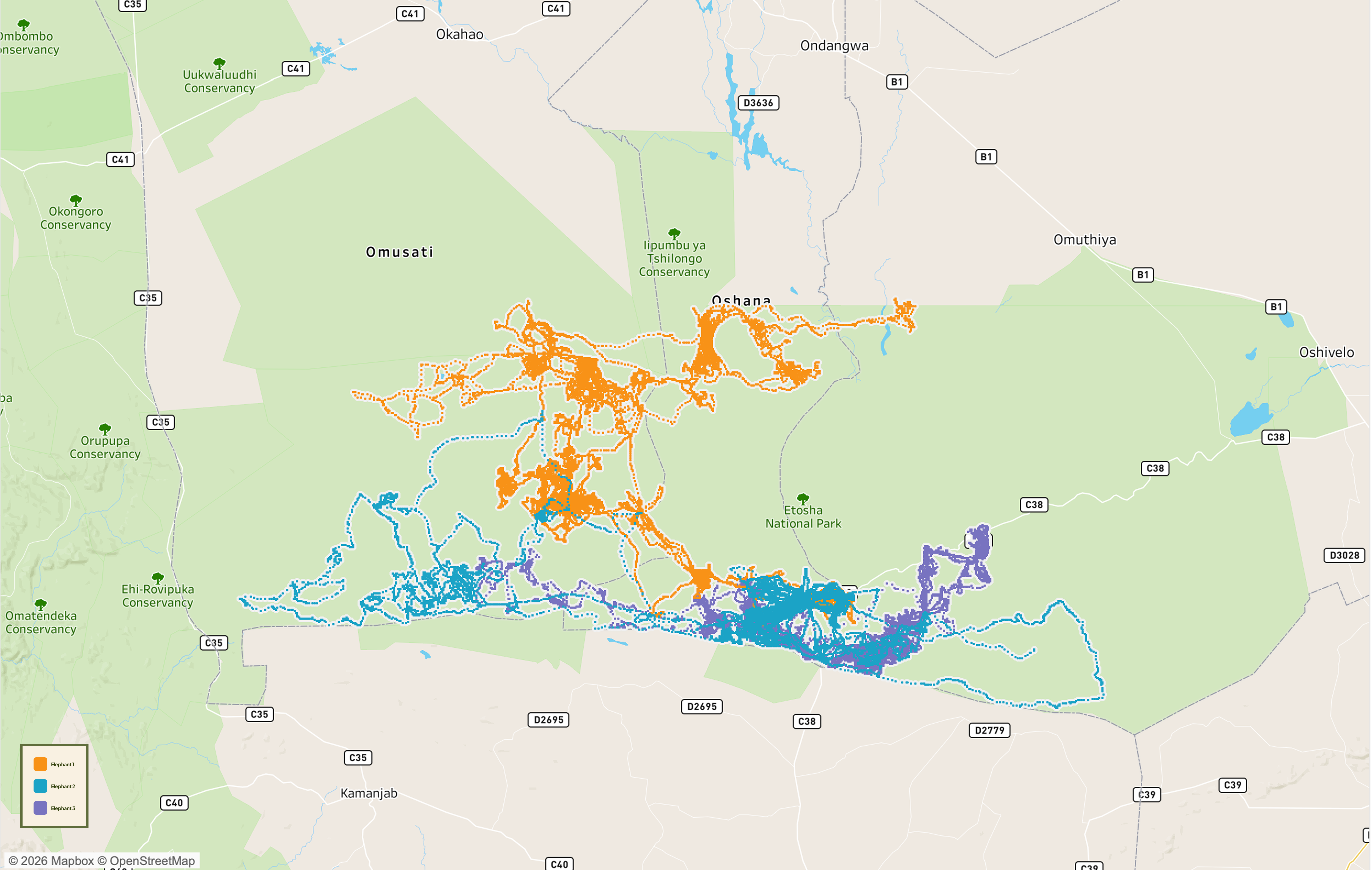
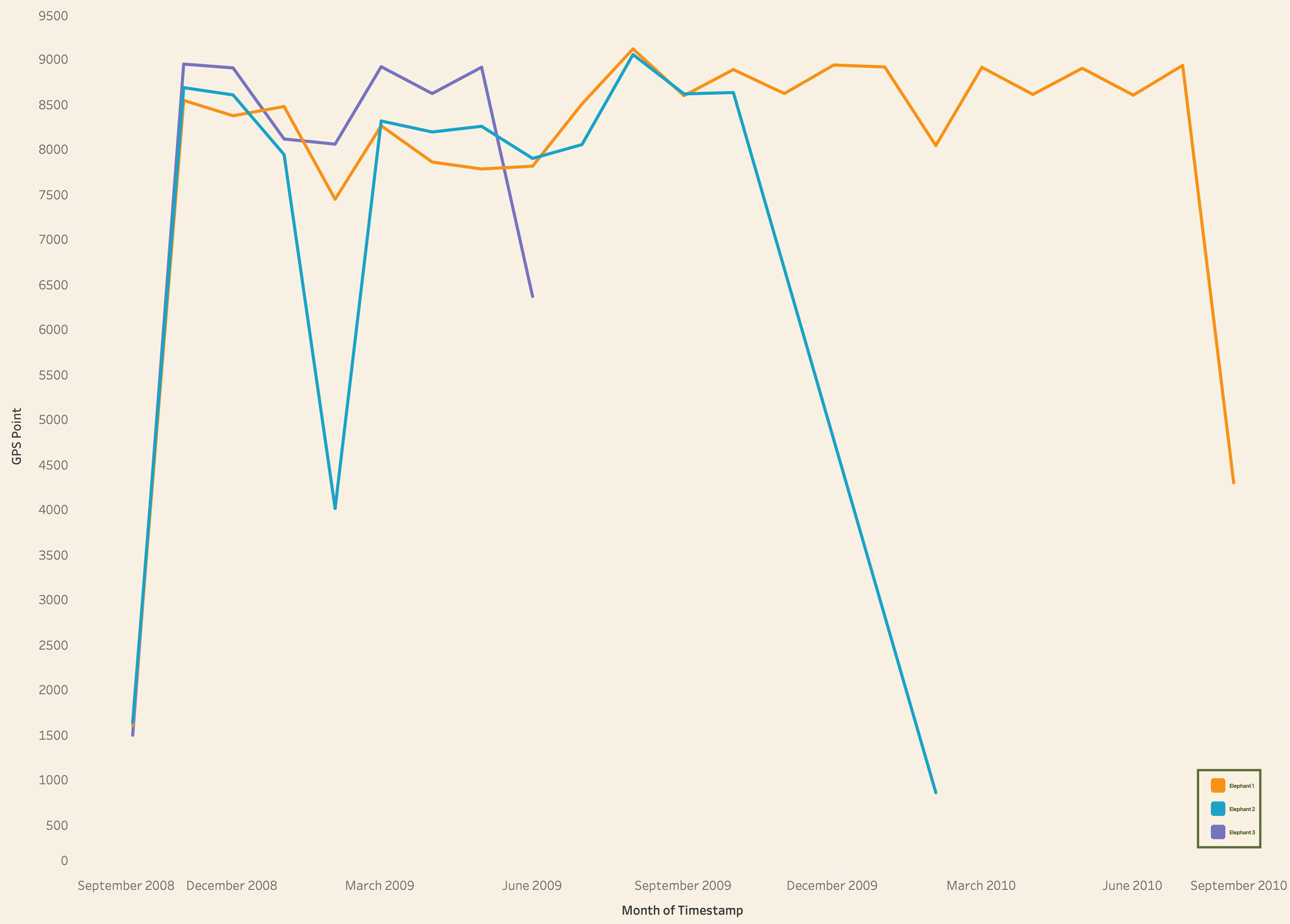
GPS data on three African Savanna Elephants in Etosha, 2008 to 2010. 351,151 location points (Tsalyuk et al., 2018). I worked it in Tableau, looking for shared activity zones, individual ranging and corridor structure.
The patterns shaped where Sentinels should sit. Cluster along shared corridors. Anchor at friction-zone boundaries. Build in redundancy, since no sensor stays online forever.
Will the elephants respond?
Three decades of research says yes. They react to recorded infrasonic calls from four kilometers away. They tell apart family, bond group and strangers. They flee recorded bee buzzing.
The Sentinel doesn't invent a new signal. It plays back alarm rumbles the herd already recognizes.
Langbauer et al. (1991), McComb et al. (2000), King et al. (2010)
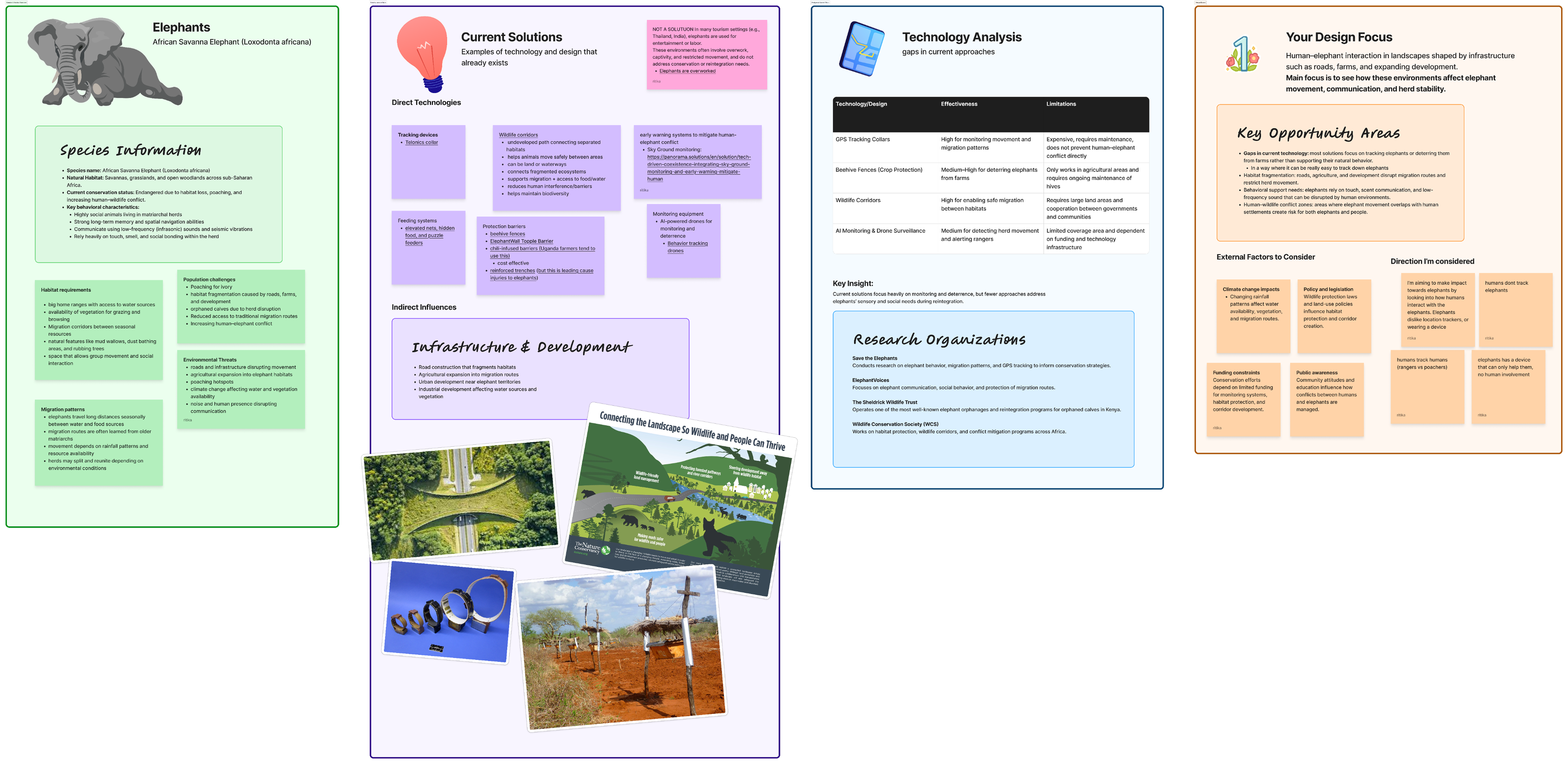
Where the three sources pointed
ITERATION
The first concept was simpler. Detect a poacher's phone signal, fire an infrasonic alert. Phones are everywhere, even among poaching crews, and radio frequency detection is easy.
It broke down fast. Three problems.
Experienced crews leave phones behind or switch frequencies. The system catches casual incursions, misses organized ones.
Rangers, researchers and tour vehicles all carry phones. The Sentinels would fire constantly. Elephants would stop trusting the alerts.
A phone signal means electronics nearby. Not poaching.
Presence detection wasn't enough. The species research pointed the way: elephants don't assess threats with one sense. No single signal is reliable alone.
A network that protects elephants should work the same way.
THE SYSTEM
Each Sentinel watches for three signals of human incursion: radio frequency, acoustic and seismic. When two of the three fire together, it emits a low-frequency infrasonic alert. Elephants hear it. Humans can't. A second app pings rangers with the location, sensor data and a camera image.
The order matters. Elephants are warned first, autonomously. Rangers respond second.
Three sensors run at once. None is enough alone.
Phones, walkie-talkies, vehicle key fobs.
Vehicle engines, gunshots, machetes, voices.
Footsteps and vehicle vibration through the ground.
Any two of the three firing together triggers an alert. One sensor alone never does — that’s what keeps false alarms out.
Authorized devices are excluded, so rangers don’t trip their own system.
The Sentinel doesn't invent a new signal. It plays back patterns the herd already knows.
A recorded alarm rumble plays at low frequency. The herd hears it like a warning from an unknown elephant. It travels through air and ground, the way their own infrasonic calls do.
The camera activates only after the alert fires. It captures one image, sends it to the ranger app and powers down. It never faces the herd.
A solar trickle charge sits in the top of the rock. No visible panel. It's built to disappear into the landscape, not announce itself.
THE APP
Live alerts up top, resolved events below. A verified badge confirms an accredited conservation organization.
Camera capture, detection summary, sensor data. Two actions: dispatch a team or flag a false positive. A privacy footer confirms no wildlife data.
Real-time status: team, vehicle, ETA, a three-step timeline. Nothing else for the ranger to do.
Every Sentinel across the protected area at a glance. Green healthy, amber alerting, gray offline. Patterns show which corridors get hit most.
REFLECTION
THE GOAL
Most anti-poaching tech turns the animal into a data point. This project pushed me to design the other way around. Working through it taught me that designing for an animal isn't a softer version of designing for a person. It's a sharper one.
The herd gets the warning. The rangers get the response.
The elephants are never the thing being watched.